I. Introduction
In port operations, mobile machinery tires directly impact costs, efficiency, and safety. Traditional experience-based management often leads to abnormal wear and short tire life. With big data, every factor — pressure, load, temperature, road conditions, and driver behavior — can be monitored and optimized.
This article presents 15 proven methods for achieving extended tire life, helping port managers reduce tire consumption and improve safety.
II. Common Types and Data Analysis of Abnormal Tire Damage
In port operations, abnormal tire damage mainly appears in the following forms. Big data statistics help determine their respective proportions, guiding management priorities:
Abnormal tread wear (approx. 35%) : Mostly caused by improper air pressure, overloading, or poor driving habits.
Sidewall cuts and bulges (approx. 25%) : Mainly due to road debris, speed bump impacts, or sharp turning.
Carcass cord/steel wire breakage (approx. 20%) : Common with improper retread selection or excessive driving speed.
Punctures and penetrations (approx. 12%) : Caused by sharp objects such as locking clips and block pavers on the road surface.
Aging cracks (approx. 8%) : Due to temperature changes and long-term improper storage.
Based on the above data, the following measures should be strictly implemented.
III. 15 Core Measures for Extended Tire Life
3.1 Maintain Proper Tire Air Pressure
Maintaining tire air pressure at the standard value is a key measure to reduce wear, eliminate hazards, and achieve extended tire life. Big data monitoring shows that when air pressure is 20% below standard, tire life can be shortened by more than 30%. Specific practices: tire technicians inflate strictly to the standard pressure; drivers check pressure before, during, and after each shift; and when necessary, technicians confirm that pressure meets requirements.
3.2 Control Tire Load — Avoid Overloading
Overloading is a direct cause of carcass steel wire breakage and blowouts. Every piece of mobile machinery has a rated load. Single-trip load data should be recorded through the operating system. Overloading alerts should be triggered promptly and incorporated into driver assessments.

3.3 Adjust Air Pressure According to Ambient Temperature
Seasonal changes affect internal tire pressure. In summer: inflate slightly below the standard value. In winter: inflate slightly above the standard value. These adjustments should be recorded to facilitate analysis of temperature effects on wear, supporting better otr tire maintenance practices.
3.4 Properly Match Tire Usage
Dual assembly: When one front tire is scrapped, the other should be replaced at the same time to avoid uneven wear from mixing new and old tires.
Pair tires with similar wear levels: The remaining tread depth difference between two tires on the same axle should not exceed 3mm.
Original tires and retreads should not be mixed on the same drive axle whenever possible.
3.5 Maximize Retreading Frequency Within Safety Limits
Retreads are mainly suitable for tractors and semi-trailers, costing only 30%–50% of original tires while achieving 70%–80% of new tire life.
Important considerations: retreads should not be installed on steering axles; old casings must be strictly screened (no cord breakage, no severe aging); and before each retread, professionals should evaluate carcass load capacity. Big data can track each tire’s retreading count and usage history — a core component of modern tire maintenance for heavy-duty fleets.
3.6 Strengthen Port Area Road Surface Cleaning
Debris such as broken block pavers, locking clips, wire pieces, and stones are major causes of punctures and cuts. A daily road inspection system should be established, with sweepers regularly cleaning operating lanes. Problem road sections should be recorded to guide targeted cleaning efforts.
3.7 Select Retread Manufacturers Carefully and Inspect Incoming Retreads
Choose retread manufacturers with ISO certification and require batch test reports. Key inspection points: no bubbles or delamination on the tread; clear sidewall markings; no exposed steel cord. Unqualified retreads must not be mounted on equipment.
3.8 Train Personnel on Retread Standards
Drivers and managers should clearly understand when a tire is eligible for retreading: tread worn to wear indicators (remaining tread depth below 1.6mm) but carcass intact; no penetrating damage; and no deep cracks on the sidewall. Tires that do not meet the standards must be scrapped — forced retreading is prohibited.
3.9 Provide Professional Training for Tire Management Staff
Management personnel should follow the “retread tire selection technical requirements” to verify whether each removed tire has retread value. Training content includes: casing appearance inspection methods, cord damage detection techniques, and aging degree judgment standards. Within safety limits, maximize the retreading rate as part of comprehensive otr tire maintenance.
3.10 Strengthen Training for Tire Technicians to Reduce Installation Damage
Common installation errors include: pry bar damage to bead edges, insufficient lubrication causing bead pulling/distortion, and misaligned valve stems. Standardize installation procedures — use dedicated tools, apply specialized lubricant, tighten nuts to specified torque — and include installation quality in performance assessments.
3.11 Strengthen Driver Training to Develop Good Operating Habits
Driving behavior can influence up to 40% of tire life. Focus on correcting: hard acceleration, sharp steering, high-speed crossing of speed bumps, and frequent hard braking. On-vehicle terminals can collect driving data to generate monthly “driving behavior reports,” rewarding top performers.
3.12 Control Driving Speed
Port driving speeds generally should not exceed 25 km/h. Measurements show that increasing speed from 20 km/h to 30 km/h increases front tire wear by approximately 50%. Speed limit signs and speed monitoring devices should be installed on key port road sections to protect port equipment tires from premature failure.
3.13 Standardize Driving Techniques
Smooth start: Confirm the hand brake is fully released, avoiding full-throttle starts.
Avoid sharp turns: Reduce speed below 10 km/h when turning to prevent excessive sidewall stress.
Reduce speed over speed bumps: Recommended speed below 5 km/h — never cross at high speed.
Drive slowly on poor road surfaces: When encountering block pavers or debris accumulation, stop to clear the area or detour.
3.14 Drivers Perform Daily Tire Maintenance
Pre-shift inspection: Check the braking system for air leaks; wheel nuts for looseness; hand brake for proper release; whether tire wear has reached scrapping standards (tread depth ≤1.6mm or sidewall bulges); and whether there are stones, wires, or nails embedded between dual tires or in the tread.
During-shift inspection: Every 2 hours or every 5 operation cycles, visually check for air leaks; verify vehicle air pressure; check for dragging brakes; and look for abnormal noises or pulling — stop immediately if any issues are found as part of routine tire maintenance while operating port equipment tires.
Post-shift inspection: Measure and record each tire’s air pressure; check for newly embedded foreign objects; record wear conditions and determine whether the tire needs to be removed for retreading.
3.15 Address Equipment-Related Problems
Some shortened tire life originates from mechanical faults. During routine maintenance and repair, focus on the following checks:
Brake dragging: Poor brake return can cause tire dragging, with localized high temperatures accelerating wear.
Loose wheel hub bearings: Causes tire wobbling and sawtooth tread wear.
Suspension system deformation: Leads to loss of wheel alignment and increased uneven wear. Properly maintaining these systems extends life of tire maintenance intervals.
Differential failure: Inconsistent rotational speeds between left and right wheels, leading to significant wear differences on drive tires.
When abnormal wear patterns are detected, prioritize inspecting equipment for these mechanical faults using data from scheduled maintenance records.
IV. Forlander Tire Brand Introduction
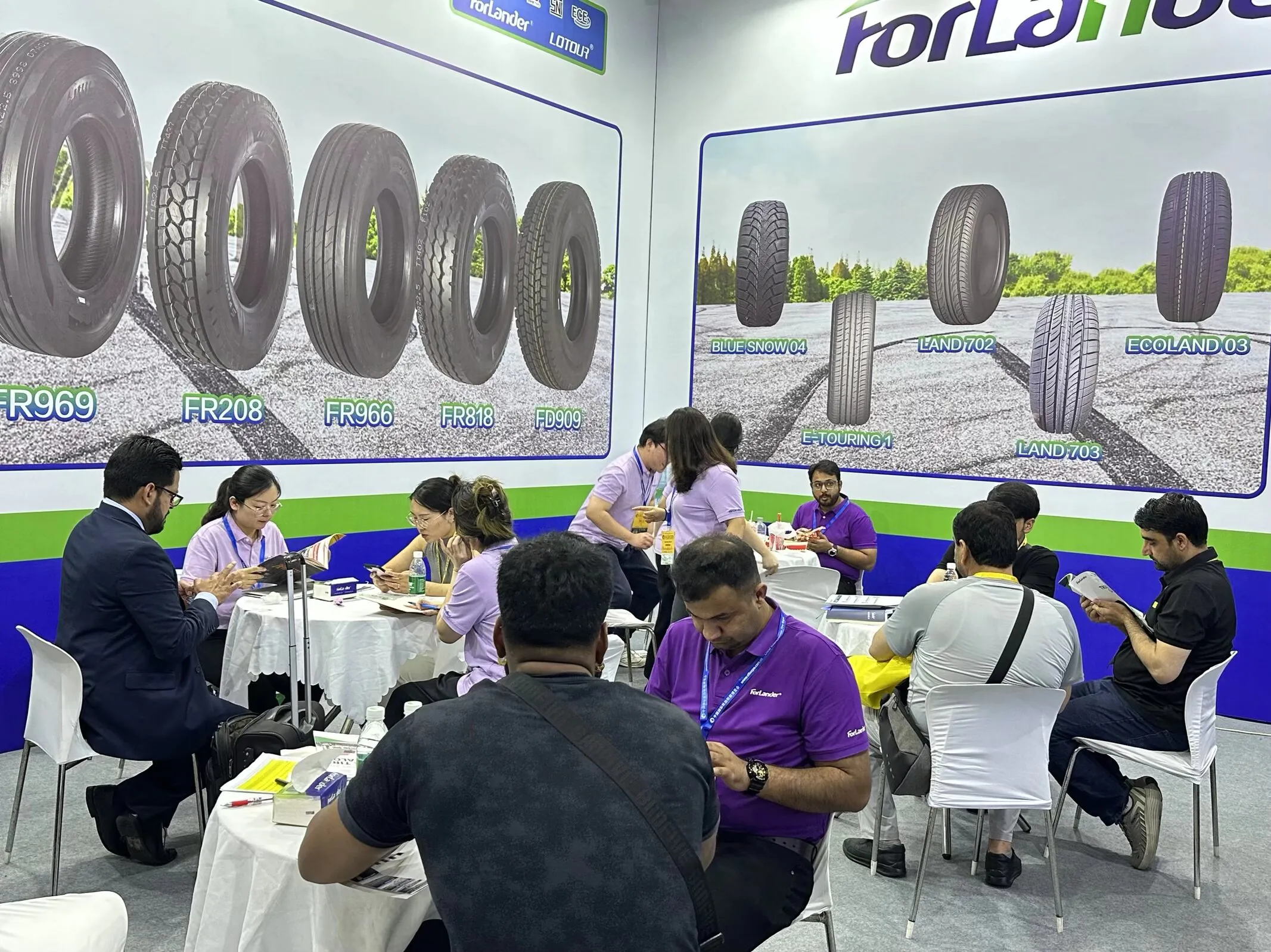
Forlander was established in 2011 as a professional high-tech construction machinery tire manufacturer headquartered in China, focusing on R&D and production of tires for port, construction, mining, and agricultural applications. The company holds international certifications including ISO9001, ISO/TS16949, CCC, DOT, and ECE.
The Forlander port tire series is specifically designed for equipment such as reach stackers, empty container handlers, rubber-tired gantry cranes (RTGs), straddle carriers, and terminal tractors. Core technical features include: cut-resistant compounds, reinforced casings, deep treads (20%-30% deeper than standard), heat resistance, and casings designed for safe retreading 1-2 times. Products are exported to over 100 countries and widely used in ports, logistics centers, and shipyards.
V. Recommended Forlander Port Tire Products
1. Forlander JU910 — For Reach Stackers and Empty Container Handlers

Size: 14.00-24 28PR
Tread depth: Approx. 60mm, 20%-30% deeper than standard tires
Key advantages: Reinforced sidewall resists lateral scraping and impacts; cut-resistant compound prevents cutting and chipping; casing can be retreaded 1-2 times, effectively reducing total cost of ownership (TCO)
2. Forlander F538-S — For Rubber-Tired Gantry Cranes and Straddle Carriers

Sizes: 14.00-24; 16.00-25; 18.00-25 44PR
Key advantages: High-rigidity bias structure withstands heavy loads and high torque; remains stable at full-load speeds below 25 km/h; strong lateral cut resistance; optimized tread pattern enhances traction on wet and paved surfaces.
3. Forlander L-5S Special Type — For Heavy-Duty Port Cranes

Size: 18.00-25 44PR
Key advantages: Extra-deep smooth tread design prevents chipping and chunking; port-specialized long-life compound for excellent wear resistance; provides high stability during lifting and transport
4. Forlander F669 IND-3 — For Container Handlers and Loaders

Sizes: 18.00-25; 21.00-25; 21.00-35; 44–48PR
Key advantages: Combines cut resistance and wear resistance; suitable for stacking, loading, and high-frequency handling applications; rugged casing adapts to high-intensity, long-duration continuous operations.
VI. Conclusion
Achieving extended tire life requires combining data-driven management with quality products. The 15 methods above — from pressure control and load limiting to driver training and equipment maintenance — work together as a system. Selecting a high-quality port tire designed for port conditions with retreadable casing, such as the Forlander port tire series, provides the foundation. With consistent data tracking and continuous improvement, a 20%–30% reduction in tire costs is achievable alongside improved safety and equipment availability.